 877-742-7701
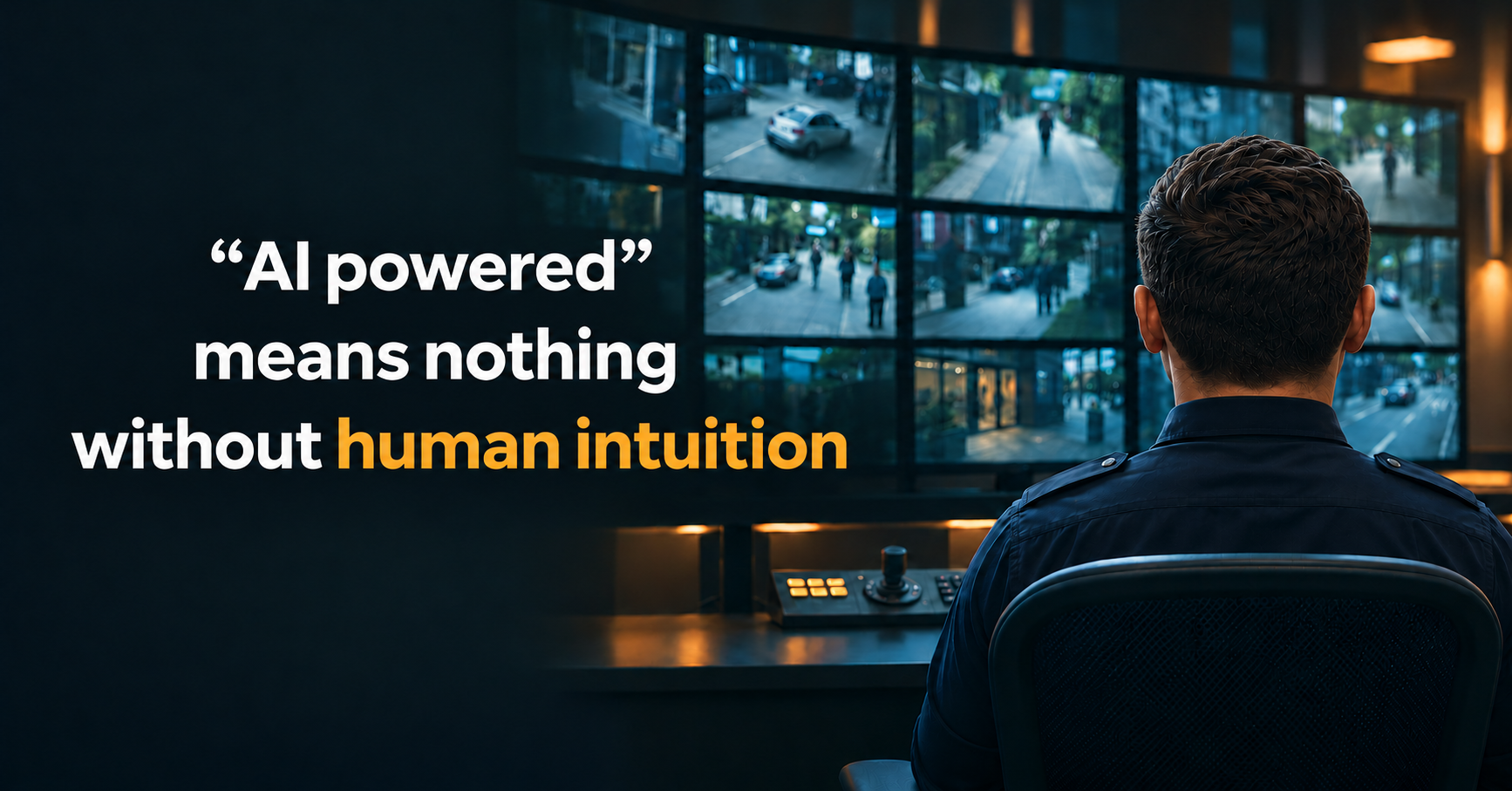
“AI-powered” means nothing without human intuition.
How much of the industry's AI messaging outpaces what's actually deployed, and what that gap means for buyers evaluating vendors.
Walk any security industry trade show floor and count how many booths avoid the phrase "AI-powered." You won't get far. The term has become so ubiquitous in physical security marketing that it has nearly stopped meaning anything at all, and that's a problem, because somewhere underneath the branding, actual AI capability does vary wildly from vendor to vendor, and buyers are rarely given the tools to tell the difference. This isn't a complaint about hype for hype's sake. It's a structural issue in how the industry sells itself, and it has real consequences for the organizations trying to buy security systems that work.
Breaking it down into its four fundamental flaws.
Three products, one label
Consider what "AI-powered" can mean in a typical product listing today. It might mean a system trained on millions of hours of footage to distinguish a person from a shadow, a package from a loitering figure, a break-in attempt from a raccoon knocking over a trash can. It might mean a rules-based motion detection algorithm with a marketing refresh, unchanged in substance for a decade but repackaged for a buzzier moniker. Or it might mean something in between: real machine learning applied to a narrow task, oversold as general intelligence.
All three get the same label. All three appear, functionally identical on paper, in the same RFP responses and sales decks. The buyer evaluating them? Often a facilities director, a risk manager, or a procurement officer without a technical security background and almost no reliable way to distinguish a mature computer vision system from a decade-old algorithm with new packaging.
Why the gap persists
Part of the problem is that AI claims are extraordinarily hard to verify from the outside. Unlike a camera's resolution or a sensor's range, model performance isn't something a spec sheet communicates in a standardized way. False positive rates, training data diversity, and real-world accuracy under adverse conditions such as rain, low light or crowded scenes are the metrics that actually matter, and they're almost never published, let alone audited by a third party.
Vendors also have limited incentive to close this gap unilaterally. If competitors can claim "AI-powered" without substantiation and face no penalty, the rational move for any single company is to match the language rather than absorb the cost of proving it. That's a classic race-to-the-bottom dynamic, and it's one that buyers rarely notice happening because every product in the category sounds equally advanced.
The result is an industry where marketing sophistication and technical sophistication have become only loosely correlated and where the companies best at the former don't always overlap with the companies best at the latter.
What buyers should actually ask
The fix isn't complicated, but it requires buyers to shift their questions. Instead of asking whether a system uses AI, the more useful question is what specific problem the model was trained to solve, and how its performance was measured. A vendor with a legitimately capable system should be able to answer concretely: what the false alarm rate looks like in a live deployment, how the model handles edge cases like poor lighting or partial occlusion, and how often it's retrained or updated as conditions change.
It's also worth asking what happens when the AI is wrong. Every model has a failure rate. The organizations that have thought seriously about their systems will have a clear answer about how false positives and false negatives are caught and corrected, whether that's human review, feedback loops, or some combination. Vendors without a real answer to that question are often the ones for whom "AI-powered" is doing more marketing work than technical work.
An industry at an inflection point
None of this means that the underlying technology isn't real or improving. Computer vision and anomaly detection genuinely have gotten better, and some deployments now do meaningfully more than the video systems of ten years ago. But the pace of marketing claims has outrun the pace of independent verification, and that mismatch is now a bigger risk to buyers than any single vendor's shortcomings.
Security is, at its core, a trust business. An industry that lets a marketing term substitute for a technical standard is quietly eroding the thing it's supposed to sell. Until that changes, through clearer disclosure norms, third-party benchmarking, or simply more informed buyers asking harder questions. Until then "AI-powered" will keep meaning everything and nothing at once.